.png?width=121&height=121&name=Untitled%20Design(13).png "Second Star Technologies IT Support Bakersfield CA Logo")
AI Phishing Is Getting Harder to Spot. Small Businesses Need a Better Plan.
Brandon Phipps
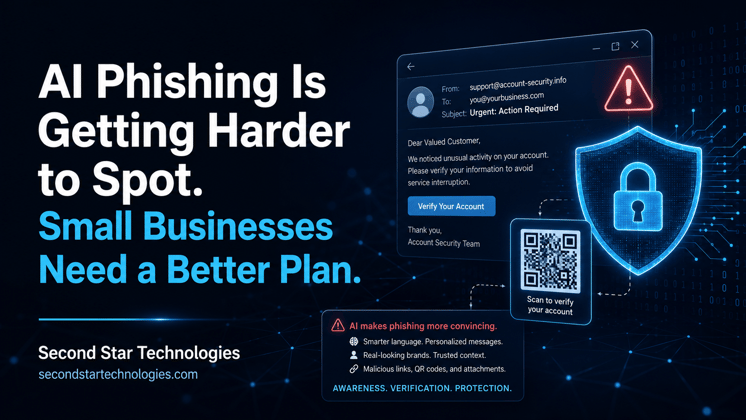
AI Phishing Is Getting Harder to Spot -- Small Businesses Need a Better Plan
8:06
Phishing used to be easier to catch.
A strange greeting. A few spelling mistakes. A weird link. A message that sounded like it came from someone who didn’t know how people actually talk at work.
That’s changing fast.
Artificial intelligence is helping attackers write cleaner, more personal, and more believable phishing emails. QR-code phishing is also growing because it pushes people away from protected work devices and onto phones, where security tools may have less visibility.
For small businesses, this creates a simple problem:
Employees can no longer rely on old warning signs alone.
The answer is not panic.
The answer is a better system.
What AI Changes About Phishing
AI does not make phishing brand new.
It makes it faster and harder to detect.
Attackers can now use large language models to create emails that sound polished, natural, and specific to the target. That matters because many employee security tips still focus on old red flags, such as bad grammar, awkward wording, or obvious formatting mistakes.
Those signs still matter.
But they are no longer enough.
Recent research on AI-generated phishing found that AI-written phishing emails can match or exceed the engagement rates of traditional phishing campaigns. In real-world simulations involving more than 71,000 emails, researchers tested traditional phishing, QR-code phishing, and AI-assisted phishing across different organizations.
The results were clear enough for small businesses to pay attention.
AI can make phishing more convincing.
That should change how teams are trained.
The main question is no longer:
“Does this email look fake?”
A better question is:
“Does this request make sense, and can we verify it another way?”
Why Small Businesses Are at Risk
Small businesses often think cybercriminals are only after large companies.
That’s not how modern phishing works.
Many attacks are built for volume. Others are built around simple business routines, such as invoices, payment changes, payroll updates, password resets, vendor notices, shipping alerts, shared documents, and Microsoft 365 login prompts.
Small businesses are attractive because they often have:
- Fewer security tools
- Less formal approval processes
- Smaller teams with broad access
- Heavy reliance on email
- Limited time for security training
- Owners or managers who approve payments quickly
That combination creates room for mistakes.
A single fake invoice can lead to a wire transfer. A fake Microsoft 365 login page can lead to a stolen mailbox. A compromised mailbox can lead to more fraud because attackers can read real conversations and reply from a trusted account.
That’s why phishing is not just an “IT issue.”
It is a business risk.
The Old Phishing Clues Are Not Enough Anymore
For years, employees were told to watch for:
- Misspelled words
- Bad grammar
- Strange formatting
- Generic greetings
- Suspicious links
- Unknown senders
- Urgent requests
Those are still useful.
But AI weakens several of them.
A phishing email can now sound calm, clear, and professional. It can match the tone of a normal business request. It can mention real names, real job titles, and real business events pulled from public sources.
That makes the message feel familiar.
And familiar messages are dangerous when people are busy.
A fake email does not need to fool everyone.
It only needs to fool one person at the wrong time.
QR-Code Phishing Creates Another Problem
QR-code phishing, often called “quishing,” adds a different layer of risk.
Instead of asking someone to click a link, the email tells them to scan a QR code. That QR code may lead to a fake login page, payment portal, document share, or account verification page.
This works because QR codes can bypass some traditional security checks. The visible link is hidden inside the image. Employees may also scan the code with a personal phone instead of a managed business device.
That matters.
Research on emerging phishing threats found that QR-code phishing was as effective as traditional phishing at getting users to visit the landing page. The same research also noted that QR-code phishing can be harder for operational detection tools to identify.
Microsoft also reported major QR-code phishing growth in early 2026. According to Microsoft Threat Intelligence, the company detected about 8.3 billion email-based phishing threats during Q1 2026. QR-code phishing increased by 146%, and business email compromise activity exceeded 10 million attacks during the same quarter.
For small businesses, this means QR codes should not be treated as harmless shortcuts.
They should be treated like links.
Business Email Compromise Is Still One of the Biggest Threats
Business Email Compromise, or BEC, is not always technical.
That is what makes it dangerous.
BEC often relies on trust, timing, and pressure. An attacker may impersonate an owner, executive, vendor, client, attorney, accountant, or manager. The message may ask someone to change payment details, send gift cards, approve a wire transfer, share payroll data, or open a fake document.
There may be no malware.
There may be no attachment.
There may be no obvious “hack” for a basic antivirus tool to catch.
Research on spear phishing and business email compromise describes these attacks as text-based and social-engineering driven. That makes them harder to define and harder to stop with traditional security controls alone.
That is why small businesses need business rules, not just software.
A good spam filter helps.
A clear payment approval process helps more.
Attackers Are Using Trusted Services
Another challenge is that phishing does not always come from sketchy-looking infrastructure.
Enterprise phishing research shows attackers can use trusted networks and legitimate services to help phishing emails get delivered. In one study, more than one-third of phishing emails in the dataset came from highly reputable networks, including major cloud providers.
That matters because many businesses still think blocking “bad” senders is enough.
It is not.
Attackers may use real services, compromised accounts, shared file platforms, form tools, cloud storage, or email platforms that employees already recognize. This makes filtering harder and makes the email feel more normal to the person reading it.
Small businesses should not rely on one layer of defense.
They need layered protection.
What Small Businesses Should Do Now
Small businesses do not need a massive security budget to reduce phishing risk.
They do need a practical plan.
Start with the areas that reduce the most risk.
Use Multi-Factor Authentication, But Choose Stronger Options When Possible
Multi-factor authentication is still one of the most important protections for business accounts.
But not all MFA is equal.
Text-message codes and basic push approvals are better than no MFA, but they can still be abused. Attackers may trick users into entering codes on fake login pages or approving sign-in prompts they did not start.
Better options include:
- Number matching
- App-based authentication
- Hardware security keys
- Passkeys
- Conditional access rules
- Device-based access controls
For Microsoft 365 environments, security defaults or conditional access policies can make a major difference when set up correctly.
Create a Verification Rule for Money and Account Changes
This is one of the simplest and most useful controls.
Any request involving money, payroll, bank details, vendor payment changes, gift cards, or sensitive records should require a second form of verification.
Do not verify by replying to the same email.
Use a trusted phone number already on file. Use a known contact method. Confirm the request outside the email thread.
A simple rule can prevent a major loss:
No payment changes by email alone.
Train Employees on Modern Phishing, Not Just Old Red Flags
Security training should match how attacks work now.
Employees should still know the old warning signs, but training should also cover:
- AI-written emails that sound professional
- QR-code phishing
- Fake Microsoft 365 login pages
- Shared document scams
- Vendor impersonation
- Payroll and direct deposit scams
- MFA approval fatigue
- Compromised email threads
- Requests that create pressure or secrecy
The goal is not to make every employee a security expert.
The goal is to slow down risky clicks and teach people when to ask for help.
Protect Email Accounts First
For many small businesses, email is the front door.
If an attacker gets into one mailbox, they may find invoices, contacts, passwords, attachments, client data, vendor conversations, and internal approval chains.
Basic email protections should include:
- Strong MFA
- Anti-phishing policies
- Spam and malware filtering
- External sender warnings
- Domain authentication using SPF, DKIM, and DMARC
- Login alerts
- Mail forwarding alerts
- Rules that detect suspicious inbox changes
- Regular review of admin accounts
Email security is not just about blocking spam.
It is about protecting the business conversations people trust every day.
Limit Admin Access
Too many small businesses give users more access than they need.
That increases damage when an account is compromised.
Use the least access needed for each role. Separate admin accounts from daily-use accounts. Do not use global administrator accounts for normal email and web browsing. Review who has access to billing, payroll, cloud storage, accounting tools, and security settings.
The fewer high-value accounts attackers can abuse, the better.
Back Up Critical Data
Phishing can lead to ransomware, account takeover, deleted files, or data theft.
Reliable backups help the business recover faster.
Backups should be:
- Automatic
- Monitored
- Protected from normal user access
- Tested on a schedule
- Stored in more than one location when possible
A backup that has never been tested is only a hope.
Test restores before you need them.
Make Reporting Easy
Employees should know exactly what to do when something feels wrong.
Make it easy to report suspicious emails, texts, QR codes, login prompts, and payment requests. Do not shame people for reporting. Do not shame people for clicking.
Shame makes people hide mistakes.
Hidden mistakes give attackers more time.
A good reporting culture sounds like this:
“Thanks for sending this over. We’ll check it.”
That response keeps people involved.
Create a Simple Phishing Response Plan
Small businesses should know what happens after someone reports a suspicious message.
A basic response plan should answer:
- Who reviews the message?
- Who checks whether anyone clicked?
- Who resets passwords if needed?
- Who checks mailbox rules and forwarding?
- Who contacts the bank if payment fraud is involved?
- Who notifies clients or vendors if a mailbox was compromised?
- Who documents what happened?
Do not wait until the middle of an incident to figure this out.
Write it down now.
What This Means for Managed IT Services
AI-driven phishing makes managed IT support more important, not less.
Small businesses need help setting up the controls, monitoring the alerts, reviewing risky sign-ins, hardening Microsoft 365, testing backups, and building response steps that match how the business actually works.
A managed IT provider can help with:
- Email security setup
- Microsoft 365 security configuration
- Multi-factor authentication
- Backup monitoring
- Endpoint protection
- Security awareness training
- Phishing response planning
- User access reviews
- Vendor and payment change workflows
- Incident response support
The goal is not to scare employees.
The goal is to build a workplace where one bad click does not turn into a business crisis.
The Bottom Line
AI is making phishing harder to spot.
QR codes are creating new gaps.
Business email compromise is still a serious financial threat.
And attackers are getting better at using trusted services to make fake messages look normal.
Small businesses do not need to solve every cybersecurity problem overnight. But they should stop relying on outdated phishing advice.
The better path is simple:
- Train employees on modern phishing
- Protect email accounts
- Require verification for payment changes
- Use stronger multi-factor authentication
- Limit admin access
- Back up critical data
- Make reporting easy
- Have a response plan before something happens
Phishing works because it targets people during normal business moments.
A stronger process makes those moments safer.
References
Luo, E., Young, L., Ho, G., Afifi, M. H., Schweighauser, M., Katz-Bassett, E., & Cidon, A. (2024). Characterizing the networks sending enterprise phishing emails. arXiv. https://doi.org/10.48550/arXiv.2412.12403
Microsoft Threat Intelligence & Microsoft Defender Security Research Team. (2026, April 30). Email threat landscape: Q1 2026 trends and insights. Microsoft Security Blog. https://www.microsoft.com/en-us/security/blog/2026/04/30/email-threat-landscape-q1-2026-trends-and-insights/
Wassermann, S., Meyer, M., Goutal, S., & Riquet, D. (2023). Targeted attacks: Redefining spear phishing and business email compromise. arXiv. https://doi.org/10.48550/arXiv.2309.14166
Weinz, M., Zannone, N., Allodi, L., & Apruzzese, G. (2025). The impact of emerging phishing threats: Assessing quishing and LLM-generated phishing emails against organizations. arXiv. https://doi.org/10.48550/arXiv.2505.12104
Brandon Phipps
Blog posts
Related Articles.

Brandon Phipps
7 Hidden IT Problems Slowing Down Your Business Right Now
{% module_block module "widget_aea3e33a-c2a1-4bca-b631-f646c8e76a7f" %}{% module_attribute "audio"...
Read more
Leave a Comment