
.png?width=121&height=121&name=Untitled%20Design(13).png "Second Star Technologies IT Support Bakersfield CA Logo")
Agentic AI for Small Business IT Support: What It Can and Cannot Do
Brandon Phipps
Agentic AI for Small Business IT Support What It Can and Cannot Do
4:12
How Agentic AI Can Help With IT Support
Agentic AI can help small businesses automate routine IT support tasks such as monitoring, ticket sorting, alert review, documentation, and basic troubleshooting. It can make IT support faster and more organized, but it should not replace experienced IT professionals. The best results come from using AI as a support tool while keeping human judgment, security oversight, and accountability in place.
Tasks and Limits
Agentic AI can use tools and follow steps toward a defined goal.
For small business IT support, it can help with:
- System monitoring
- Help desk ticket triage
- Alert summaries
- Documentation
- Basic troubleshooting
- Predictive maintenance
- Knowledge base updates
It cannot replace:
- Human judgment
- Cybersecurity expertise
- Business risk decisions
- Compliance review
- Strategic IT planning
- Complex troubleshooting
What Is Agentic AI?
Most people know AI through chatbots.
A chatbot usually waits for a prompt, gives an answer, and stops there. Agentic AI goes further by using tools, following steps, gathering information, and working toward a defined goal.
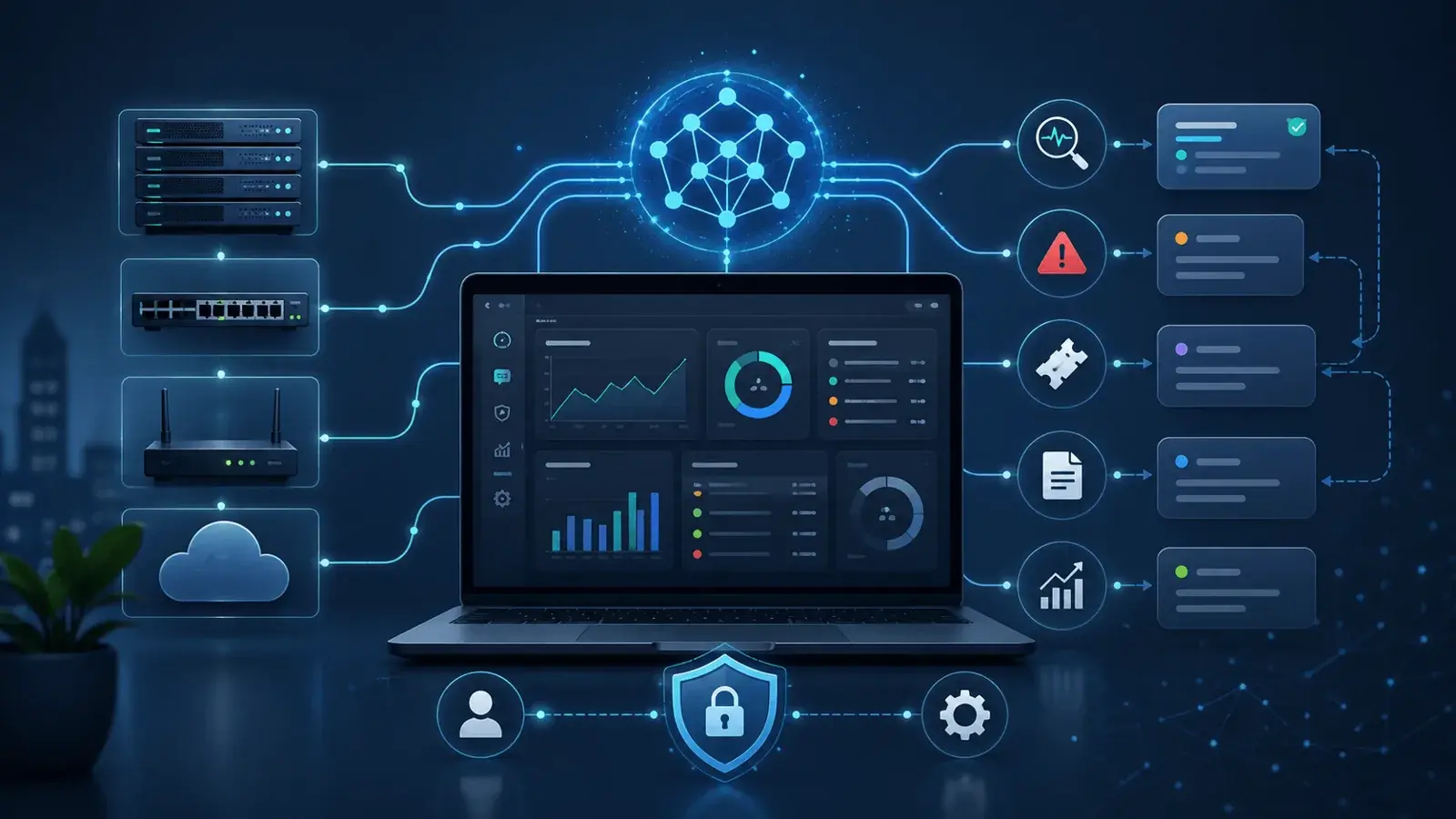
In an IT support setting, an agentic AI system might review a warning from a server, check related logs, compare recent activity, summarize the likely issue, and recommend a next step.
In some environments, it may also perform approved actions, such as restarting a service, opening a ticket, collecting diagnostic data, or notifying the right technician.
That makes agentic AI different from basic automation.
Traditional automation follows a fixed rule. Agentic AI can evaluate context, choose between possible steps, and adapt its workflow based on what it finds.
Why Does Agentic AI Matter for Small Businesses?
Small businesses often depend on technology but do not always have large IT departments.
A single network outage, failed backup, security alert, or email problem can interrupt work across the entire company. Many small business IT problems also begin quietly before users notice anything is wrong.
Agentic AI can help by watching systems, sorting information, and reducing the amount of repetitive work required from technicians.
That does not mean the technology is perfect.
Small businesses still need skilled IT support to make decisions, manage risk, secure systems, and make sure automation does not create new problems.
How Can Agentic AI Help Small Business IT Support?
How Can Agentic AI Improve System Monitoring?
Many IT problems show early warning signs.
A workstation may start running out of storage. A server may show unusual resource usage. A backup may fail overnight. A network device may begin dropping connections.
Agentic AI can help by monitoring signals across systems and turning scattered data into useful information. Remote monitoring and management (RMM) supports ongoing monitoring and maintenance; AI tools should work within that support process.
For example, agentic AI can help review:
- Server performance
- Workstation health
- Cloud service alerts
- Backup status
- Network activity
- Security logs
- Application errors
This gives IT teams a better chance of catching issues before they become outages.
Research in AIOps, or Artificial Intelligence for IT Operations, has focused heavily on using AI to detect incidents, predict failures, identify root causes, and support automated actions (Ahmed et al., 2022; Cheng et al., 2023).
For a small business, the practical benefit is simple: fewer surprises and faster visibility when something starts going wrong.
How Can Agentic AI Help With Help Desk Tickets?
Help desk work can become overwhelming when every request lands in the same inbox.
A password reset, a printer problem, a security warning, a failed backup, and a network outage should not all be treated the same way. Some tickets are routine. Others need urgent attention.
Agentic AI can help sort and prepare tickets before a technician works on them.
It can:
- Read incoming requests
- Identify the likely issue
- Categorize the ticket
- Suggest a priority level
- Route the request to the right person
- Summarize the problem
- List possible next steps
This helps technicians spend less time sorting tickets and more time solving problems.
AI-based incident management research has shown that intelligent systems can support incident classification, assignment, and resolution workflows (Ahmed et al., 2023).
For small businesses, this can improve response times without removing the human technician from the process.
How Can Agentic AI Reduce Alert Fatigue?
IT systems generate a lot of alerts.
Some alerts are important. Some are duplicates. Some are false positives. Some are symptoms of the same root problem.
When technicians receive too many alerts, the real danger is that important warnings get missed.
Agentic AI can help by grouping related alerts, identifying patterns, and summarizing what likely matters most.
For example, instead of sending five separate warnings about one affected server, an AI system may summarize the event as:
“A server resource issue appears to be affecting email sync, file access, and backup completion. Recommended next step: review disk usage and recent service errors.”
That kind of summary saves time.
Research on autonomous cloud operations has explored how AI agents may support complex tasks such as fault localization, root cause analysis, and operational response (Chen et al., 2025; Shetty et al., 2024).
For a small business, the value is not full autonomy. The value is clearer information, faster review, and fewer wasted hours chasing noise.
How Can Agentic AI Improve IT Documentation?
Documentation is one of the most important parts of IT support, but it is often neglected.
Technicians are busy. Small issues pile up. Notes get left incomplete. Troubleshooting steps stay in someone’s head instead of being added to a shared knowledge base.
Agentic AI can help create better documentation during and after support work.
It can draft:
- Ticket summaries
- Troubleshooting notes
- Incident reports
- Standard operating procedures
- Internal knowledge base articles
- User-facing instructions
- Change logs
This does not mean AI-generated documentation should be accepted without review.
A technician should still verify accuracy before adding it to official records.
The benefit is that AI can create a strong first draft, capture details faster, and reduce the chance that useful information gets lost.
How Can Agentic AI Support Predictive Maintenance?
Predictive maintenance means finding signs of trouble before a system fails.
In IT support, this may include noticing when a device is running out of storage, a server is showing repeated errors, or a backup system is becoming unreliable.
Agentic AI can help by reviewing patterns over time.
It can look for:
- Repeated backup failures
- Unusual login activity
- Rising resource usage
- Disk health warnings
- Network performance changes
- Application crash patterns
- Endpoint security events
This can help small businesses move from reactive IT support to proactive IT support.
Reactive support waits for something to break. Proactive support looks for the warning signs and fixes problems earlier.
That difference matters because downtime costs time, money, and trust.
What Can Agentic AI Not Do?
Can Agentic AI Replace Human IT Judgment?
No. Agentic AI cannot replace human IT judgment.
IT support is not only technical. It also involves business priorities, risk tolerance, budget, compliance, user needs, and timing.
For example, an AI system may recommend restarting a server because a service is failing.
A technician may know that restarting the server during business hours would interrupt accounting, dispatch, sales, or customer service.
The AI recommendation may be technically valid, but the human decision still matters.
Keep a person responsible for reviewing the results and approving decisions that need judgment.
Can Agentic AI Guarantee Cybersecurity?
No. Agentic AI cannot guarantee cybersecurity.
AI can help identify suspicious behavior, summarize alerts, and support investigations. It can also speed up response when properly configured.
However, cybersecurity still requires human expertise.
Threat actors adapt. Security tools generate false positives. Business context matters. Some decisions require careful review before action is taken.
An AI system may flag unusual activity, but a qualified professional should decide what the activity means and how the business should respond.
Small businesses should not view agentic AI as a replacement for layered security.
They still need:
- Strong passwords
- Multi-factor authentication
- Secure backups
- Endpoint protection
- Patch management
- Firewall management
- Email security
- Security awareness training
- Incident response planning
Agentic AI can support these controls, but it does not replace them.
Can Agentic AI Be Fully Trusted Without Oversight?
No. Agentic AI should not be fully trusted without oversight.
The more authority an AI system has, the more risk it can create if it makes a mistake, misunderstands context, or takes the wrong action.
Recent research has raised concerns about highly autonomous AI systems because greater autonomy can increase safety, accountability, and control risks (Mitchell et al., 2025).
For IT support, this matters because technical actions can affect real business operations.
An AI system with too much access could:
- Disable the wrong account
- Restart the wrong service
- Misread a security alert
- Delete useful data
- Apply the wrong configuration
- Escalate a minor issue incorrectly
- Miss a serious threat
This is why businesses should use guardrails.
Agentic AI should have clear limits, approval requirements, logging, access controls, and human review for important decisions.
Where Can Small Businesses Use Agentic AI Safely Today?
Most small businesses should start with low-risk, high-value use cases.
The best starting point is usually AI-assisted support, not fully autonomous support.
Strong first steps include:
- Ticket categorization
- Ticket summaries
- Alert summaries
- System health reporting
- Documentation drafts
- Knowledge base updates
- Backup status summaries
- Basic troubleshooting guidance
- Routine maintenance checklists
These tasks can save time without giving AI too much control.
Once the business gains confidence, AI can support more advanced workflows with approval steps.
For example, an AI system may recommend clearing temporary files, restarting a non-critical service, or collecting diagnostic logs. A technician can approve the action before it happens.
That keeps the process efficient without removing accountability.
What Should Small Businesses Avoid?
Small businesses should be careful with any AI setup that takes action without review.
Higher-risk use cases include:
- Automatically deleting files
- Changing firewall rules
- Disabling user accounts
- Modifying backup settings
- Changing security policies
- Applying patches without testing
- Responding to security incidents without approval
- Making compliance-related decisions
These actions can affect security, operations, and legal exposure.
They should remain under human control unless the business has strong policies, testing, logging, and rollback procedures.
What Does a Good Human-AI IT Support Model Look Like?
A strong model uses AI to speed up the work while humans remain responsible for decisions.
The best structure looks like this:
- AI monitors systems and gathers information.
- AI summarizes alerts and tickets.
- AI recommends possible next steps.
- A technician reviews the recommendation.
- The technician approves, changes, or rejects the action.
- The system logs what happened.
- The documentation is updated.
This keeps the benefits of automation while preserving human judgment.
For small businesses, this is usually the safest and most practical path.
What Should Small Businesses Ask Before Using Agentic AI?
Before adding agentic AI to IT support, a business should ask clear questions.
- What systems will the AI be allowed to access?
- What actions can it take without approval?
- Who reviews AI recommendations?
- How are actions logged?
- Can changes be reversed?
- What happens if the AI makes a mistake?
- How is sensitive data protected?
- Does the tool meet our security and compliance needs?
- Who is accountable for the final decision?
These questions help prevent a common mistake: adding powerful automation before defining the rules.
How Should Small Businesses Start?
Small businesses should start with a practical, controlled rollout.
A good first phase may include:
- AI-generated ticket summaries
- AI-assisted documentation
- Alert grouping
- Backup report summaries
- Basic knowledge base drafts
- Technician-reviewed recommendations
This gives the business value without handing over critical control.
The second phase can add approved automation.
For example, the AI may prepare a remediation step, but a technician must approve it before the system acts.
The third phase may include more advanced workflows for mature environments with strong monitoring, access controls, and rollback plans.
The goal is not to automate everything.
The goal is to automate the right things safely.
Frequently Asked Questions
Will agentic AI replace managed IT services?
"
No. Agentic AI can automate repetitive IT support tasks, but it does not replace managed IT services.
Small businesses still need experienced IT professionals for cybersecurity, infrastructure planning, compliance support, vendor management, backup strategy, disaster recovery, and complex troubleshooting.
" Is agentic AI safe for small businesses?
It becomes riskier when it can take high-impact actions without approval. Small businesses should start with AI-assisted workflows before allowing autonomous changes.
Can agentic AI improve cybersecurity?
"
Yes, agentic AI can support cybersecurity by reviewing alerts, identifying suspicious patterns, summarizing events, and helping technicians investigate faster.
It should not be treated as a complete security solution. Cybersecurity still requires human review, layered tools, policies, and response planning.
" Is agentic AI affordable for small businesses?
"
In many cases, yes. Small businesses do not always need to build custom AI systems.
Many IT management, help desk, cybersecurity, and monitoring platforms are adding AI-assisted features. The more practical question is whether the feature saves time, improves visibility, and can be managed safely.
" What is the biggest risk of agentic AI in IT support?
"
The biggest risk is giving AI too much control too quickly.
Small businesses should avoid allowing AI to make major security, infrastructure, or data decisions without human approval. Automation should be useful, limited, logged, and reviewed.
"
Final Thoughts
Agentic AI can improve small business IT support by reducing repetitive work, organizing alerts, summarizing tickets, drafting documentation, and helping technicians respond faster.
It is not a replacement for experienced IT professionals.
The best use of agentic AI is as a force multiplier. It helps IT teams see problems sooner, understand issues faster, and spend less time on manual sorting and documentation.
Small businesses should approach agentic AI with realistic expectations.
AI can monitor, summarize, recommend, and assist. Humans still need to decide, verify, secure, and take responsibility.
The future of IT support is not AI alone. The stronger model is AI-enhanced IT support, where automation handles routine work and qualified professionals handle judgment, strategy, and accountability.
Call to Action
If your business is spending too much time dealing with recurring IT problems, slow support requests, failed backups, security alerts, or unclear documentation, it may be time to review your IT support process.
Second Star Technologies can help small businesses evaluate their current IT systems, identify routine tasks that can be improved, and build a practical support strategy that balances automation, security, and human oversight. Review our managed IT services in Bakersfield to compare ongoing support options.
References
Ahmed, S., Singh, M., Doherty, B., Ramlan, E., Harkin, K., & Coyle, D. (2022). AI for Information Technology Operation (AIOps): A review of IT incident risk prediction. 2022 9th International Conference on Soft Computing & Machine Intelligence (ISCMI), 253–257. https://doi.org/10.1109/ISCMI56532.2022.10068482
Ahmed, S., Singh, M., Doherty, B., Ramlan, E., Harkin, K., Bucholc, M., & Coyle, D. (2023). Knowledge-based intelligent system for IT incident DevOps. 2023 IEEE/ACM International Workshop on Cloud Intelligence & AIOps, 1–7. https://doi.org/10.1109/AIOPS59134.2023.00005
Allam, H., AlOmar, B., & Dempere, J. M. (2025). Agentic AI for IT and beyond: A qualitative analysis of capabilities, challenges, and governance. The Artificial Intelligence Business Review. https://doi.org/10.64044/j63vmh26
Chen, Y., Shetty, M. M., Somashekar, G., Ma, M.-J., Simmhan, Y. L., Mace, J., Bansal, C., Wang, R., & Rajmohan, S. (2025). AIOpsLab: A holistic framework to evaluate AI agents for enabling autonomous clouds. arXiv. https://doi.org/10.48550/arXiv.2501.06706
Mitchell, M., Ghosh, A., Luccioni, A., & Pistilli, G. (2025). Fully autonomous AI agents should not be developed. arXiv. https://doi.org/10.48550/arXiv.2502.02649
Prakash, S., & Komal, A. (2025). Architecting agentic AI for IT operations: Design principles for enhanced automation and resilience. International Journal of Scientific Research in Science, Engineering and Technology. https://doi.org/10.32628/IJSRSET2512107
Sekar, A. (2025). AIOps: Transforming management of large-scale distributed systems. European Journal of Computer Science and Information Technology. https://doi.org/10.37745/EJCSIT.2013/vol13n5117
Shetty, M. M., Chen, Y., Somashekar, G., Ma, M.-J., Simmhan, Y. L., Zhang, X., Mace, J., Vandevoorde, D., Las-Casas, P., Gupta, S. M., Nath, S., Bansal, C., & Rajmohan, S. (2024). Building AI agents for autonomous clouds: Challenges and design principles. Proceedings of the ACM Symposium on Cloud Computing. https://doi.org/10.1145/3698038.3698525
Sirigiri, K. (2025). AI in DevOps: A framework for predictive maintenance and automated issue resolution. International Journal of Applied Mathematics. https://doi.org/10.12732/IJAM.V38I2S.83
Sivakumar, S. (2024). Agentic AI in predictive AIOps: Enhancing IT autonomy and performance. International Journal of Scientific Research and Management. https://doi.org/10.18535/ijsrm/v12i11.ec01

Brandon Phipps
Brandon Phipps is the owner of Second Star Technologies in Bakersfield, California. His work includes business computer and network support, cybersecurity services, and backup and disaster recovery planning. He writes practical business technology resources for the Second Star Technologies website. Connect with Brandon on LinkedIn.
Leave a Comment